
On 11–12 February 2026, the Mutual Learning Seminar “Access to Social Protection for Workers and the Self-Employed – Pension Awareness and the Role of Digitalisation” took place in Brussels. Organised by DG EMPL, the event brought together national representatives and experts to discuss best practices and innovative ideas for improving access to pension protection for both employees and the self-employed, with a particular focus on raising awareness of pension-related issues.
The seminar centred on two key thematic strands:
- effective communication strategies for enhancing pension awareness, and
- the use of digital tools—particularly pension information and tracking systems—to foster transparency and participation, including among non-standard workers.
Two thematic discussion papers, circulated in advance, prepared participants for the seminar’s focus areas and helped structure deliberations over the two days. Both papers underlined the need to prioritise individuals in non-standard or underinsured forms of employment and stressed that digital solutions must be accompanied by inclusive, easily accessible communication strategies.
Day 1: Engaging Presentations and Constructive Dialogue
The first day opened with a presentation by Prof. Dr. Lisa Brüggen, who had already contributed as a scientific advisor to the ETS pilot project. She introduced the core points of her paper on pension awareness and communication, setting the thematic stage with her talk, “Pension engagement: What Works, for Whom, and Why?” She pointed out that many citizens—especially younger people, low-qualified workers, the self-employed, and those in atypical forms of employment—either do not know or underestimate their future pension entitlements. She outlined various approaches to designing targeted communication strategies, such as campaign-based or life-stage specific messaging and interventions prompted by major life events (e.g. employment status changes, parental leave). She also highlighted behavioural incentives to encourage early and continuous engagement with retirement planning.
Subsequent sessions presented practical examples of pension awareness campaigns from a range of Member States. Participants then engaged in group discussions based on the guiding questions of the first discussion paper, exploring how different population groups (by age, gender, education level, and employment status) can best be reached and motivated to address their pension provision early on and at key transition points in their working lives.
In the afternoon, discussions turned to digitalisation and innovative methods for delivering pension information. Presentations on European and national policy approaches related to supplementary pensions were followed by case studies on digital pension information tools in Belgium and Germany. In parallel working groups, participants examined issues such as user-friendliness, trust-building, data protection, and the inclusion of non-standard workers in digital services, seeking to identify success factors and common challenges in developing user-centric online pension portals.
Day 2: National PTS and the European Tracking Solution
The second day built upon the discussion paper by Anders Lundström, focusing on the development, application, and interconnection of Pension Tracking Systems (PTS). After an introductory overview by Anders on the functioning and benefits of national PTS, several Member States—including the Czech Republic, Croatia, and the Netherlands—presented their approaches to digitally enabled pension information and tracking systems followed by a pannel discussion having present also representatives of ETS members like Regos from Croatia as well as the Dutch Pension Tracking Service and Sigedis from Belgium.
After that a presentation of the European Tracking Service (ETS) brought the attention to the need of mobile workers to receive understandable pension information cross countries. Claudia shared the latest updates on the rollout of the ETS—a perfect fit for this event. In her presentation, she highlighted the fact that connections to the ETS can not only be done by so called PTS. Presenting a map of Europe and the situation regarding the existence or offering of NTS, comprising different pillars, but also in many cases „only“ digital pension information of the statutory pensions (presented by Statutory Pension Institutions), she explained that PTS normally comprise the given national pension landscapes when it comes to the different pillars. Therefore, the PTS but also ETS will just mirror what the landscapes include and a connection to the ETS could be built by different players, not only PTS.
In subsequent working sessions, participants discussed central design and implementation issues: technical and legal requirements for developing or expanding national PTS (including integration of all pension pillars), strategies for phased versus comprehensive implementation, and the practical and legal challenges of achieving interoperability between national systems and the ETS in the context of labour mobility of workers. A concluding panel summarised the main insights from the group discussions and formulated policy recommendations and proposals for further cooperation at EU level.
Conclusions and Key Takeaways
The seminar, together with the accompanying papers and discussions, clearly demonstrated that strengthening pension awareness and ensuring access to clear, consolidated, and comprehensible pension information are fundamental prerequisites for effective social protection of all workers, including the self-employed and those in non-standard employment.
The workshop successfully provided a platform to share concrete good practices and design principles for targeted communication strategies, including the use of digital tools. It is hoped that the insights and exchanges will further stimulate the development and expansion of national pension tracking systems, thereby facilitating broader integration with the European Tracking Service and www.Findyourpension.eu.
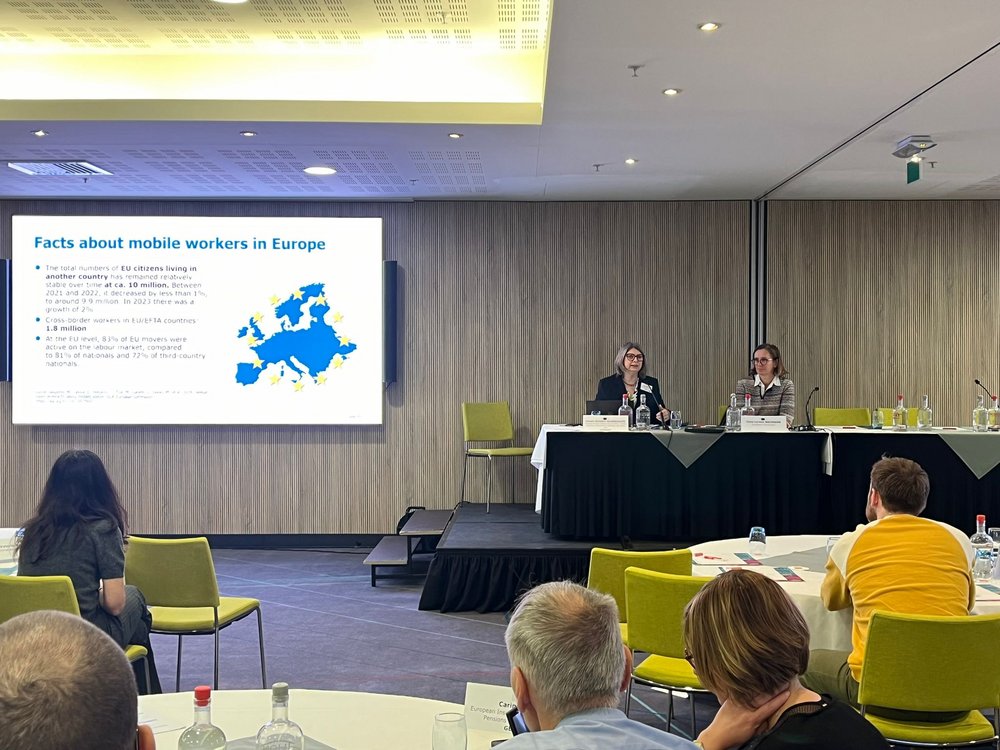
From the left: Claudia Wegner-Wahnschaffe and Dana Carmen Bachmann