10.1 million mobile workers: Why Cross-Border Pension Information Matters
Growing Labour Mobility Reinforces the Need for Cross-Border Pension Information
On 19 February 2026, the European Commission’s Directorate-General for Employment, Social Affairs and Inclusion (DG EMPL) published the 2025 edition of the Annual Report on Intra-EU Labour Mobility, providing an updated overview of mobility trends across the European Union (EU) and European Free Trade Association (EFTA) countries. The report provides valuable insights into the target group for which ETS was established: mobile workers who have worked in multiple EU countries during their careers. We are pleased to share some key findings with you.
Europe on the move: structural mobility in the European labour market
The report confirms that labour mobility remains a structural feature of the European labour market. In 2024, approximately 10.1 million working-age EU citizens lived in a Member State other than their country of citizenship, representing around 3.9% of the EU working-age population. In addition, nearly 1.9 million individuals lived in one country while working in another, illustrating the continued importance of cross-border employment within the Union. Overall, around 14 million EU citizens of all ages now reside in another Member State, reflecting the scale of mobility within the EU single market. A potential of 14 million users for our platform FindYourPension!
Germany, Spain, Italy: where do European citizens move
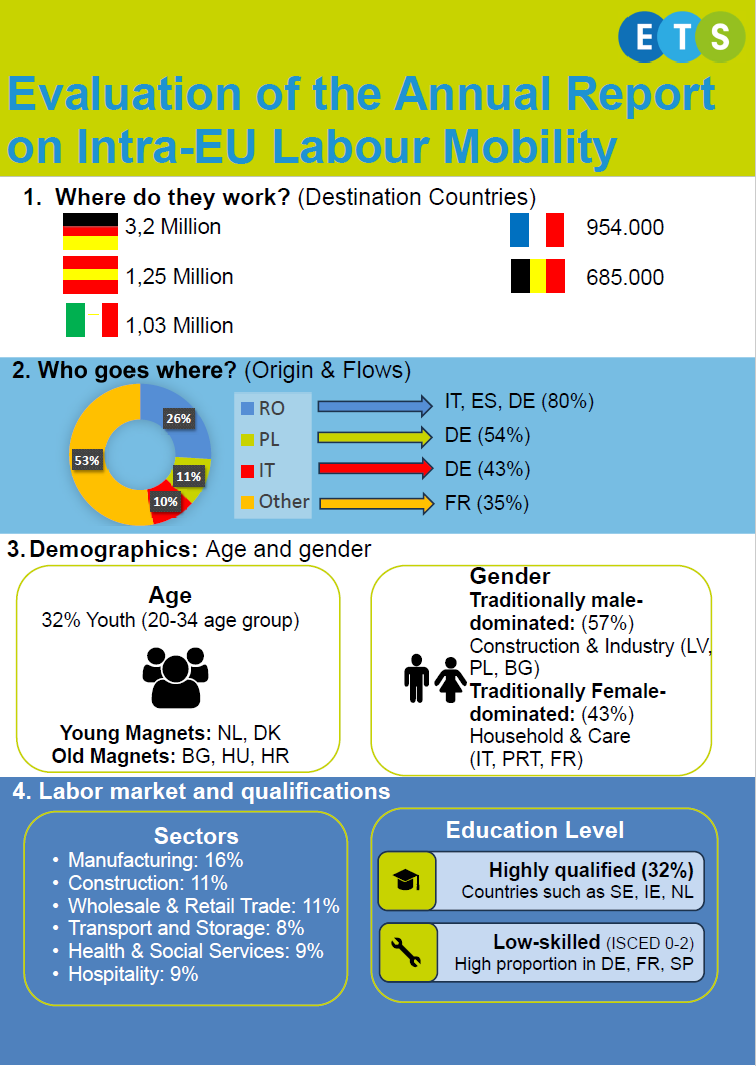
Mobility is not spread evenly across Europe. According to the figures highlighted in the report, around 26% of all EU migrants come from Romania, followed by Poland with 11% and Italy with 10%. At destination level, Germany hosts by far the largest number of EU migrants, with around 3.2 million, or roughly one third of the total EU migrant population. It is followed by Spain, Switzerland, Italy and France. In relative terms, Luxembourg stands out even more strongly, with EU migrants representing around 40% of its total population. Cross-border commuting also remains concentrated in a number of countries. France records the largest number of commuters living in one country and working in another, with around 460,000 people, followed by Poland and Germany. At the same time, outward mobility flows remain substantial: the highest emigration is recorded by Romania, Germany, Italy, Poland and Spain
From short stay to long-term mobility
While the growth of mobility has slowed compared with earlier decades, cross-border mobility has increasingly become a long-term component of many Europeans’ careers. A growing share of EU movers remains in their host country for extended periods: the proportion of mobile citizens living in their host country for less than ten years declined from 53% in 2012 to 43% in 2024. It reflects the consolidation of earlier mobility waves and stronger labour market integration.
Increasing diversity in mobility trajectories
Mobility trajectories are also becoming more diverse. Many Europeans now build professional careers that span several countries over time, moving between Member States at different stages of their working life, building careers that span several labour markets and several pension systems. A visible trend in the report is also the increase in return mobility. In 2023, around 759,000 working-age EU citizens returned to their home countries, showing that intra-EU mobility often has a circular dimension rather than following a simple one-way pattern. The Commission had already identified this circularity in the previous edition of the report, and the latest figures suggest that this trend is continuing.
Not just for the young: who are today’s mobile workers?
Another notable trend concerns the age profile of mobile workers. Mobility is increasingly observed among workers in mid- and later-career stages. In 2024, around 1.27 million EU citizens aged 40–70 had moved to another Member State within the past decade, illustrating that cross-border mobility is no longer limited to young workers at the beginning of their careers. More broadly, the profile of EU migrants is quite diverse. Around 32% are aged 20 to 34, 40% are between 35 and 49, and 28% are between 50 and 64. Men still represent the majority of incoming working-age EU migrants, accounting for 57% compared with 43% women. Education levels are also mixed: 32% of EU migrants have a high level of education, while 29% have a low level of education. This shows that mobility concerns not only highly qualified professionals, but workers with a broad range of backgrounds and career paths. The report also points to an employment structure that still includes strong representation in industry, wholesale and retail, and transport and storage, while at the same time showing a growing role for more knowledge-based professions. The previous Commission reporting had already highlighted the rising education level of EU movers, and the 2025 edition continues in that direction.
ETS simplifies cross-border pension tracking for mobile workers
As workers move between countries during their careers, they may accumulate pension rights in several national pension systems. While EU social security coordination rules ensure that these rights are preserved, obtaining a clear overview of entitlements across different countries can remain complex for citizens. In this context, the European Tracking Service (ETS) on Pensions contributes to improving transparency for mobile citizens. By connecting national pension tracking systems, ETS allows individuals to access information on their accrued pension rights through a central access point. Personalized, secure and no matter where in Europe they’ve worked. By making pension information more accessible, ETS helps citizens better understand and plan their retirement in an increasingly mobile European labour market